Does your patio or small garden feel more like a cramped corridor than a peaceful escape? Your garden’s size isn’t the problem; it’s how our brains perceive it. With a few design tricks, you can make that tiny space feel twice as big.
Smart landscaping guides the eye, creating a sense of depth and mystery. It’s not magic, but an understanding of perception. These simple, DIY-level secrets can dramatically alter your garden’s feel, proving good landscape design is your most powerful tool for creating a spacious outdoor retreat.
The 15-Minute Fix: How Decluttering and Colour Create Instant Space
The fastest way to create space is to start with what you already have. Is your patio or balcony a jumble of mismatched, small pots? This visual clutter makes a space feel chaotic and cramped. The fix is simple: use fewer, but larger, planters. One or two bold, statement pots create a calm, intentional focal point that instantly feels more spacious than a dozen tiny ones.
To enhance that sense of calm, create a cohesive colour story. When your planters and any small furniture share a similar colour palette—think all-terracotta, or shades of cool grey—your eye doesn’t have to work so hard. This simple trick unifies the space, making it feel calmer and therefore larger. It’s an easy weekend project that swaps visual noise for a serene, pulled-together look.
Finally, consider the boundaries of your garden. A dark fence or wall can feel like it’s closing in. Just like in a small room, light colours are your best friend here. A coat of paint in a pale grey, warm white, or even a soft sky blue will reflect sunlight and make those boundaries seem to recede. This optical illusion is one of the most effective ways to make your garden feel open and inviting.
Think Up, Not Just Out: Why Vertical Space is Your Secret Weapon
With your garden floor decluttered, the next trick is to look up. Most small spaces have a huge, untapped resource: their walls and fences. Leaving this area bare makes the space feel flat and one-dimensional. By drawing the eye upward, you create an illusion of grandeur and use square footage that was previously going to waste. This is one of the best solutions for a narrow garden.
Going vertical is simple and can be done in an afternoon. You don’t need a massive construction project to add this new dimension. Try one of these easy methods:
- Add a trellis for climbing plants like jasmine or clematis.
- Use tiered planters that stack greenery without a large footprint.
- Hang baskets from a sturdy hook, awning, or pergola.
This shift in perspective transforms a flat garden into a lush, three-dimensional room. By turning a blank wall into a living feature, your garden feels more immersive and complete, freeing up precious floor space for a comfortable chair or small table.
Create a Journey: How a Winding Path Adds Mystery and Depth
If your garden has a straight path from the back door to the fence, you’ve essentially laid down a measuring tape. The eye shoots straight to the end, instantly registering the garden’s true—and often small—size. There’s no surprise, no discovery.
Now, imagine that path meanders. By introducing a gentle curve with simple stepping stones, you prevent the eye from seeing the destination all at once. This creates the feeling of a journey, making the small garden layout feel longer and more engaging. It’s a reliable trick for creating depth.
To really sell this illusion, place a taller plant or a single large pot so it partially blocks the view around the bend. This simple concealment is powerful; it creates mystery and makes the brain ask, “What’s back there?” That hint of another space waiting to be seen is all it takes to add a wonderful sense of depth.
The ‘Secret Room’ Strategy: Why Dividing Your Garden Makes it Feel Bigger
One of the most effective ways to make a small garden feel larger is to divide it. This builds on the idea of creating a journey; instead of seeing the whole space at once, you’re creating distinct ‘zones’ or ‘rooms’ that invite exploration. Like a small home with defined rooms, the separate areas feel like more space to discover.
You don’t need to build walls to achieve this. The goal is suggestion, not solid separation. A simple, freestanding trellis with a climbing plant, a decorative screen, or even a cluster of three tall planters can act as a soft divider. This partial concealment is a powerful trick for any layout, especially a long, narrow garden, as it breaks up the ‘bowling alley’ effect and adds intrigue.
Once you have your dividers, give each new ‘room’ a purpose. One zone might be a quiet corner with a single chair, while another holds the barbecue. By placing a small garden focal point in each zone—like a unique pot, a birdbath, or a striking sculpture—you give the eye a reason to stop and appreciate the area before moving on. You’ve turned one small garden into multiple destinations, expanding its feel and function.
Fool the Eye with Plants: A Pro Trick Called Forced Perspective
Artists can make a flat canvas look like a deep, rolling landscape, and you can use that same optical illusion in your garden with your choice of plants. This trick is one of the most powerful tools for making a small space feel expansive.
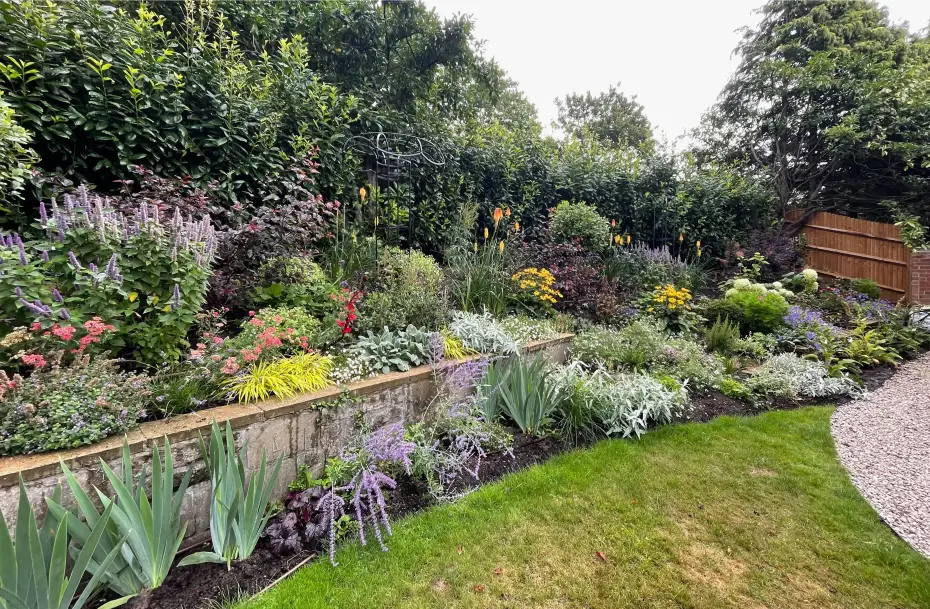
The secret is playing with leaf size and colour. Start by placing plants with large, bold leaves—like the broad foliage of a hosta—at the front of your garden bed. To make them pop, choose plants with warm-coloured flowers or leaves, like reds, oranges, and yellows. These big, bright plants feel closer to you.
Next, position plants with fine, delicate foliage—think feathery ferns or wispy grasses—at the very back. For these background plants, lean into cool colours like blues, purples, and pale silvers. Your brain naturally sees these smaller textures and softer colours as being farther away.
When you combine these elements, you’re creating what designers call forced perspective. The dramatic shift from big, warm plants in the front to fine, cool plants in the back tricks the eye into perceiving more distance, making your garden feel significantly deeper without moving a single fence.
Your New, Spacious Garden: Putting It All Together
Where you once saw a cramped patio or garden, you can now see potential. You’ve moved beyond simply wishing for more space and into understanding how to create it. These are your tools for crafting the illusion of depth, mystery, and wonder right outside your door.
You don’t need to tackle everything at once. Start with one project, like decluttering your pots or unifying their colour scheme, and build your confidence from there. By thinking vertically, creating a winding path, dividing the space into ‘rooms’, and using forced perspective with plants, you can craft an outdoor sanctuary. This guide isn’t just about making your garden look bigger—it’s about making it feel better, proving the best retreats aren’t measured in square feet, but in moments of quiet joy.